

Skin & Medical Treatments
Laser tattoo removal
Laser breaks tattoo ink into fragments small enough for your immune system to clear over the following weeks. That clearance is why sessions are spaced six to eight weeks apart, and why the process cannot be rushed.
How many sessions you need depends on things nobody can fully judge from a photograph.
Why nobody can promise you a number
Black and dark blue inks respond best. Green and light blue are stubborn. Red is variable. Yellow, white and some pastel shades often barely respond at all.
Amateur tattoos usually clear faster than professional ones, because the ink sits shallower and is less densely packed. Older tattoos clear faster than recent ones. Tattoos on the lower legs and feet clear more slowly than those on the chest or back, because circulation drives the clearance.
A realistic range for a professional black tattoo is six to twelve sessions. Multi-coloured work can need more, and not every tattoo clears completely.
Who it suits, and who should wait
It suits:
- an old or homemade tattoo
- a tattoo you want lightened so an artist can cover it
- a design or a placement you have outgrown
- and colour work, if you want a straight answer about the odds before you start.
It is not for you, or not yet, if:
- you are under 18
- the area is tanned or fake-tanned, until the tan has gone
- you are pregnant
- you need it gone by a set date, because a course takes months and cannot be rushed
- or you want a promise that it will clear completely, which nobody can honestly give.
Some medicines, including certain antibiotics and acne treatments, make skin more sensitive to light, so tell us everything you take, and whether you form raised or keloid scars. Your skin type is checked at the patch test, and if our laser is not right for it, we will say so rather than treat you.
If you're planning a cover-up
You usually do not need complete removal. Three to five sessions to lighten the existing work often gives a tattooist enough to work with, at a fraction of the cost and time of full clearance. Talk to your artist first and bring us their view.
From patch test to your last session
Consultation and patch test
Both are free. We look at the colours, size, age and position of your tattoo, check your skin type, and test the laser on a small area. You leave with your price and a range for the number of sessions.
Your first session
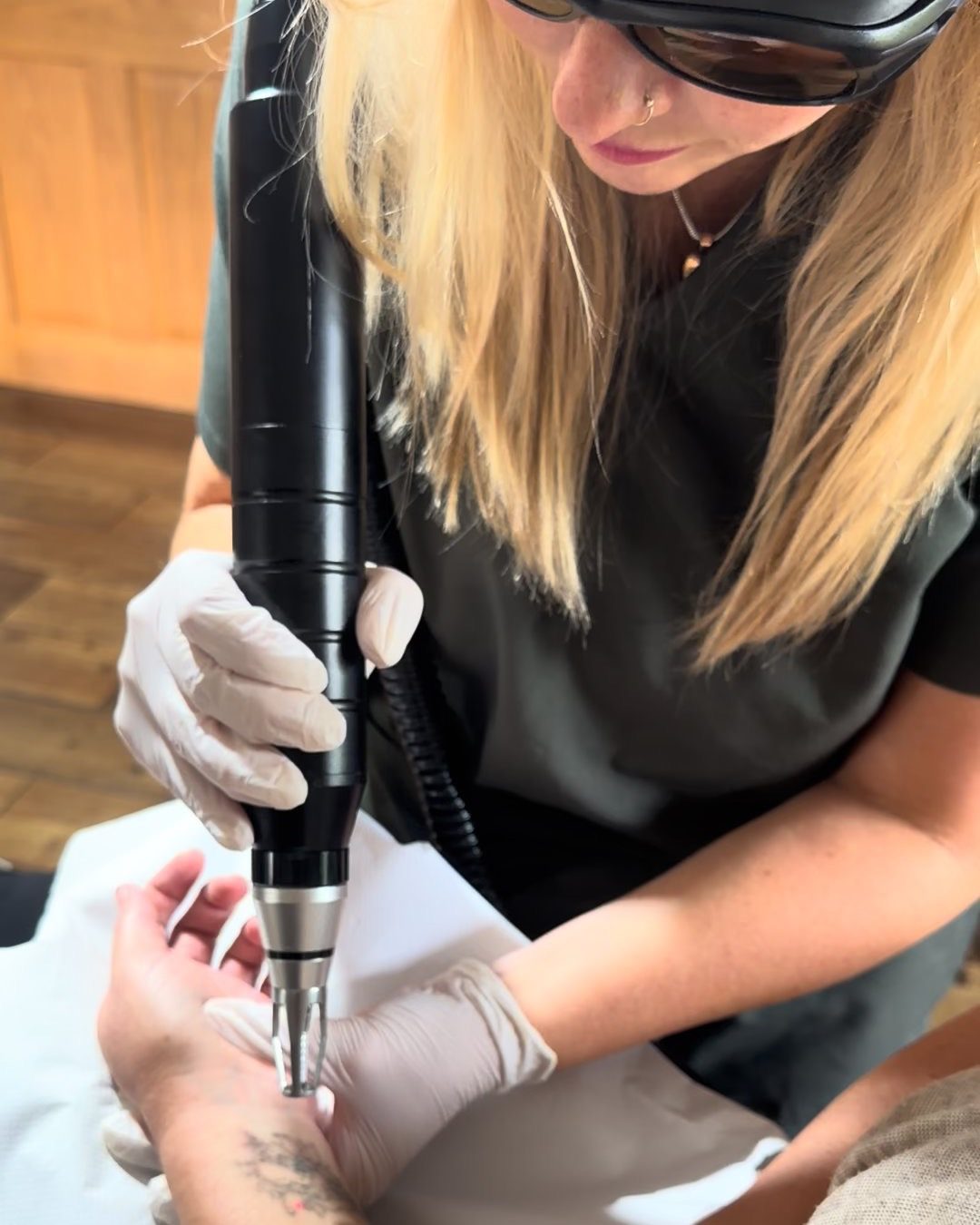
At least 24 hours after the patch test. You wear eye protection while the laser passes over the tattoo, and most people compare it to an elastic band flicking against the skin.
Six to eight weeks between sessions
Your body clears the broken-up ink in the gap, which is why sessions cannot be closer together.
Further sessions
Each one breaks up more ink. We check how far the tattoo has cleared at every visit, and tell you when a colour has stopped responding.
When to stop
For a cover-up, when your artist says there is enough room to work. Otherwise, when the tattoo has gone, when you are happy with it, or when it will not lighten any further.
After each session the skin is red and raised, and blisters are common in the first day or two. Scabs follow and come away on their own: leave them alone. Keep the area out of baths, pools and saunas until it has healed, and protect it with high-factor sun cream between sessions.
What it costs
The course figures are at £45 a session. A small professional black tattoo typically needs six to twelve sessions, and lightening one for a cover-up typically takes three to five. Larger tattoos cost more per session. The consultation and patch test are free, and the price for your tattoo is confirmed at the patch test, before treatment starts.
What makes a tattoo quicker or slower to remove
Seven things decide how many sessions a tattoo takes. For each, see which description fits yours. If most of yours sit under 'usually fewer', you are likely to need fewer sessions than usual, and if most sit under 'usually more', more. It cannot give you a number, and nor can a photograph: your range comes at the patch test.
Usually fewer sessions
- Skin tone
- Lighter skin.
- Where it is
- Head, neck, chest or back.
- Colours
- Black or dark blue only.
- How much ink
- Fine lines, a simple design or homemade ink.
- The skin
- Smooth and flat.
- Layering
- A single tattoo.
- Age
- Many years old.
Usually more sessions
- Skin tone
- Darker skin, which is treated at gentler settings to protect it.
- Where it is
- Lower arms, hands, lower legs or feet, where circulation is weaker.
- Colours
- Several colours. Green and light blue are stubborn, red varies, and yellow, white and pastel shades may barely respond.
- How much ink
- Dense shading, solid fill or detailed professional work.
- The skin
- Ink in scarred or raised skin.
- Layering
- A tattoo that already covers an older one.
- Age
- Recent.
People clear ink at different rates, so this is a guide rather than a prediction.
Common questions
How many sessions to remove a tattoo?
For a professional black tattoo, typically six to twelve, spaced six to eight weeks apart. Amateur tattoos usually clear faster. Green, light blue, yellow and white inks respond poorly, and not every tattoo clears completely. Anyone giving you a firm number from a photograph is guessing.
I only want it lightened for a cover-up — is that cheaper?
Considerably. Three to five sessions is often enough to give a tattooist something to work with, at a fraction of the cost and time of full clearance. Speak to your artist first and bring us their view.
Will my tattoo be completely removed?
It depends on the tattoo and on you. Some tattoos clear completely. Others lighten a long way but leave a faint shadow or outline, and some colours barely respond. Black and dark blue usually respond best. You will get an honest view of yours at the patch test, before you commit to anything.
What will the whole course cost?
From £45 a session for the smallest tattoos, so a small professional black tattoo that needs six to twelve sessions comes to £270 to £540. Lightening one for a cover-up usually takes three to five sessions, so £135 to £225. Larger tattoos cost more per session. Your price is confirmed at the free patch test, before treatment starts.
Does laser tattoo removal hurt?
Most people compare it to an elastic band flicking against the skin. You can ask for a break at any point, and how to keep you comfortable is talked through at your consultation.
What will my skin look like afterwards?
Red and raised at first, and blisters are common in the first day or two. Scabs follow and come away on their own. Leave both alone, because picking makes scarring more likely.
Can laser tattoo removal scar or change my skin colour?
Scarring is uncommon, but possible. Treated skin can also turn lighter or darker, which usually settles over a few months, and pale or skin-toned inks can darken under the laser. Tell us if you form raised scars, and follow the aftercare.
Can you remove coloured tattoos?
We will look at yours and tell you the odds. Black and dark blue respond best. Red varies. Green and light blue are stubborn, and yellow, white and pastel shades often barely respond.
Is laser tattoo removal suitable for darker skin?
It can be, and it is checked at your consultation and patch test. Darker skin is treated at gentler settings to protect it, which can mean more sessions. If our laser is not right for your skin, we will say so rather than treat you.
Who will treat me?
Alicia Marsland, the clinic's nurse prescriber, or a member of her small team. Whoever treats you is fully trained in laser tattoo removal, and the clinic is fully insured.
Is there an age limit?
Yes. You must be 18 or over.